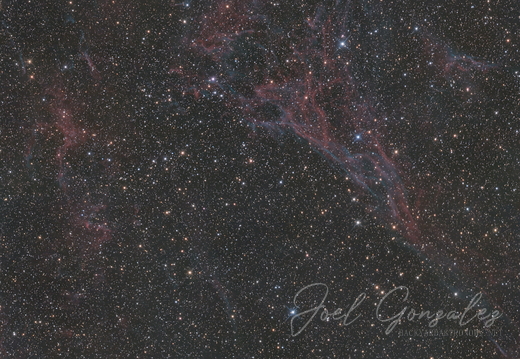
NGC 6979 - Pickering's Triangle (Supernova Remnant)
NGC 6979, also known as Pickering's Triangle or Fleming's Triangular Wisp, is a bright filamentary portion of the Cygnus Loop (Veil Nebula) supernova remnant in the constellation Cygnus. It was discovered by Williamina Fleming in 1904 and named after Edward Charles Pickering, director of Harvard College Observatory.
Distance: ~2,400 light-years
Apparent Size: Part of the 3-degree Cygnus Loop
Constellation: Cygnus
Object Type: Supernova Remnant (part of Veil Nebula / Cygnus Loop)
Key Features:
- Brightest at the north-central edge of the Cygnus Loop
- Thin, thread-like filaments glowing from shock-wave collisions
- Part of a supernova explosion ~10,000-20,000 years ago
- Luminous knots on the northern rim between NGC 6992 and NGC 6960
- Strong Ha and OIII emission
- Spans ~40 light-years of space
Best Imaging Season: June - October
Optimal Integration: 15+ hours (Ha/OIII narrowband)