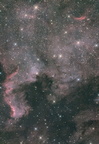
Backyard Astronomy Gallery / Nebulas / Barnard 312
Barnard 312 (B312) is a large, prominent dark nebula in the constellation Scutum, located roughly 2,000 light-years away within the rich star fields of the Milky Way. Positioned near the Eagle Nebula (M16) and Omega Nebula (M17), it appears as a stark, mushroom shaped silhouette against a dense, bright backdrop of stars.
Dark nebulae like B312 are dense clouds of interstellar dust and gas that block visible light from objects behind them, creating striking void like shapes against illuminated star fields. First catalogued by Edward Emerson Barnard in his 1919 photographic survey of dark nebulae, B312 is one of the most visually dramatic entries in the catalogue.
Imaged with an Orion 8 inch Newtonian reflector and Canon T3i (full spectrum modified), 46x180s exposures captured in N.I.N.A 3.1 and stacked in Siril 1.4.0.
Backyard Astronomy Gallery / Nebulas / LDN 1719
LDN 1719, also known as Barnard 41, is a dark nebula in the constellation Scorpius near the border with Ophiuchus. Positioned at RA 16h 19m, Dec -20 07', it spans roughly 47 arcminutes (0.61 square degrees) and sits in the northern part of Scorpius, in the region of the scorpion's claws, not far from the well known Rho Ophiuchi cloud complex. Nearby stars include Psi and Chi Ophiuchi and Nu Scorpii, with the Blue Horsehead Nebula (IC 4592) also in the vicinity. Unlike emission or reflection nebulae that glow with their own light, dark nebulae like LDN 1719 reveal themselves by what they hide. They are dense concentrations of interstellar dust and molecular gas that block visible light from stars and illuminated gas behind them, appearing as inky voids or silhouettes against a brighter background. First systematically cataloged by Beverly Lynds in 1962 from photographic plates, the LDN catalog contains over 1,700 such objects. LDN 1719 is one of many dark clouds in the Scorpius-Ophiuchus region, an area rich with molecular clouds, star forming activity, and colorful nebulae that together make up one of the closest and most active star forming regions to our solar system at roughly 400 light years distance.
Backyard Astronomy Gallery / Star Clusters / M53
M53 - Globular Cluster
M53 is a globular cluster in Coma Berenices, one of the more distant clusters visible in amateur telescopes. It appears near the star Diadem.
Distance: 58,000 light-years
Apparent Magnitude: 7.60
Apparent Size: 13'
Constellation: Coma Berenices
Object Type: Globular Cluster (Class V)
Key Features:
- One of more distant globulars
- ~500,000 stars
- Age: 12.7 billion years
- 220 light-years diameter
- Near NGC 5053 (fainter companion)
Best Imaging Season: March - June
Optimal Integration: 5+ hours