Backyardastronomy.net

Astrophotography Gallery

M1 (Crab Nebula)
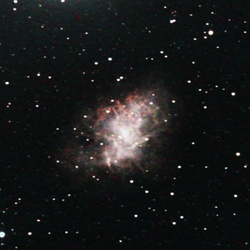
M1 (Crab Nebula)
M1 - Crab Nebula The Crab Nebula is a supernova remnant in the constellation Taurus, the result of a supernova observed by Chinese astronomers in 1054 AD. It's one of the most studied objects in the night sky. Distance: 6,500 light-years Apparent Magnitude: 8.40 Apparent Size: 7' × 5' Constellation: Taurus Object Type: Supernova Remnant (SN 1054) Key Features: - Pulsar at center (neutron star, 30 rotations/second) - Expanding at 1,500 km/s - Source of strong X-ray and gamma emission - First object in Messier's catalog - Supernova recorded July 4, 1054 Best Imaging Season: November - March Optimal Integration: 8+ hours for filament detail
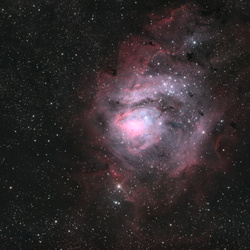
M8 (Lagoon Nebula)
M8 (Lagoon Nebula)
M8 - Lagoon Nebula The Lagoon Nebula is a giant emission nebula and one of the finest nebulae for astrophotography. It contains an open cluster (NGC 6530) and shows stunning dark lanes and bright regions. Distance: 4,100 light-years Apparent Magnitude: 6.00 Apparent Size: 90' × 40' (3x Moon) Constellation: Sagittarius Object Type: Emission Nebula (HII region) Key Features: - Contains open cluster NGC 6530 - Hourglass Nebula structure inside - Multiple dark lanes (Barnard 88, 89, 296) - Active star formation region - Visible to naked eye under dark skies Best Imaging Season: June - September Optimal Integration: 10+ hours (Ha/OIII/LRGB)
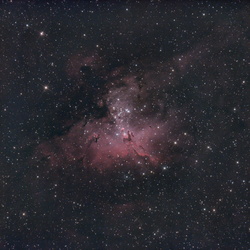
M16 (Eagle Nebula)
M16 (Eagle Nebula)
M16 - Eagle Nebula The Eagle Nebula is a young open cluster surrounded by emission nebulosity, famous for the "Pillars of Creation" imaged by the Hubble Space Telescope. Distance: 7,000 light-years Apparent Magnitude: 6.40 Apparent Size: 70' × 50' Constellation: Serpens Cauda Object Type: Emission Nebula + Open Cluster Key Features: - "Pillars of Creation" - star-forming columns - Contains NGC 6611 cluster (8,100 stars) - Stellar spire structure - Active star formation - Iconic Hubble target Best Imaging Season: June - September Optimal Integration: 15+ hours for pillars
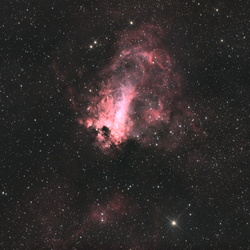
M17 (Omega Nebula)
M17 (Omega Nebula)
M17 - Omega Nebula The Omega Nebula (also called Swan Nebula or Horseshoe Nebula) is an emission nebula and star-forming region, one of the brightest and most massive HII regions in our galaxy. Distance: 5,000 light-years Apparent Magnitude: 6.00 Apparent Size: 15' × 11' Constellation: Sagittarius Object Type: Emission Nebula (HII region) Key Features: - Swan/Omega shape from dark dust lanes - Contains ~800 stars (100+ early-type) - Massive molecular cloud behind - Active star formation - No surrounding star cluster visible Best Imaging Season: June - September Optimal Integration: 8+ hours
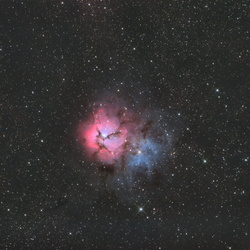
M20 (Trifid Nebula)
M20 (Trifid Nebula)
M20 - Trifid Nebula The Trifid Nebula is a rare combination of emission, reflection, and dark nebulae, divided into three parts by dark dust lanes (hence "trifid" meaning three-part). Distance: 5,200 light-years Apparent Magnitude: 6.30 Apparent Size: 28' × 28' Constellation: Sagittarius Object Type: Emission + Reflection + Dark Nebula Key Features: - Red emission nebula (Ha) - Blue reflection nebula (north) - Three dark lanes dividing it - Contains open cluster - Young stellar objects Best Imaging Season: June - September Optimal Integration: 10+ hours (LRGB/Ha)
M27 (Dumbbell Nebula)
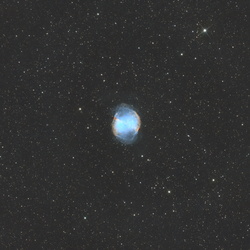
M27 - Dumbbell Nebula The Dumbbell Nebula is a large planetary nebula, the first of its type discovered. Its distinctive dumbbell shape comes from the expanding shell of gas ejected from a dying star. Distance: 1,360 light-years Apparent Magnitude: 7.50 Apparent Size: 8' × 5.7' Constellation: Vulpecula Object Type: Planetary Nebula Key Features: - Largest planetary nebula by angular size - Central white dwarf (largest known) - Expanding at 31 km/s - Contains knots of gas and dust - Age: ~14,600 years Best Imaging Season: June - October Optimal Integration: 6+ hours (OIII strong)
M42 (Orion Nebula)
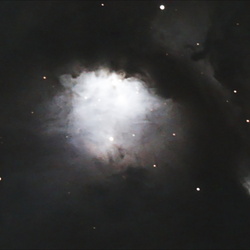
M42 (Orion Nebula)
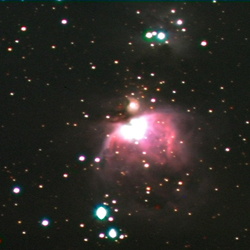
M42 - Orion Nebula The Orion Nebula is the brightest nebula visible from Earth and the closest massive star-forming region to our solar system. It's visible to the naked eye as the middle "star" in Orion's sword. Distance: 1,344 light-years Apparent Magnitude: 4.00 Apparent Size: 85' × 60' (2.5x Moon) Constellation: Orion Object Type: Emission Nebula (HII region) Key Features: - Nearest massive star-forming region - Contains Trapezium cluster (4 bright stars) - 700+ young stars - Protoplanetary disks observed - Visible to naked eye - Most photographed nebula Best Imaging Season: November - March Optimal Integration: 5+ hours (short due to brightness)
M57 (Ring Nebula)
M57 (Ring Nebula)
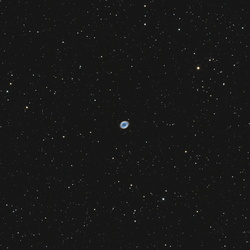
M57 - Ring Nebula The Ring Nebula is a planetary nebula in Lyra, appearing as a small smoke ring in telescopes. It's one of the most famous planetary nebulae and easy to find between Beta and Gamma Lyrae. Distance: 2,283 light-years Apparent Magnitude: 8.80 Apparent Size: 1.4' × 1.0' Constellation: Lyra Object Type: Planetary Nebula Key Features: - Classic ring-shaped planetary - Central white dwarf (15th magnitude) - Barrel-shaped shell viewed pole-on - Multiple shell structure - Expanding at 20-30 km/s Best Imaging Season: May - September Optimal Integration: 4+ hours
M76 (Little Dumbbell Nebula)
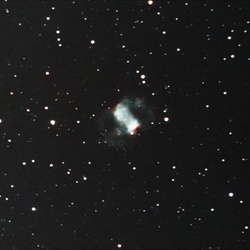
M76 - Little Dumbbell Nebula M76 is a planetary nebula that resembles a smaller version of M27. It has a complex structure with two lobes and faint outer halos. Distance: 2,500 light-years Apparent Magnitude: 10.10 Apparent Size: 2.7' × 1.8' Constellation: Perseus Object Type: Planetary Nebula (bipolar) Key Features: - Bipolar structure - Two bright lobes - Faint outer halo - Central star magnitude 16.6 - Challenging for small telescopes Best Imaging Season: September - February Optimal Integration: 8+ hours
M78
M78
M78 - Reflection Nebula M78 is the brightest reflection nebula in the sky, a cloud of interstellar dust illuminated by nearby hot young stars. It's part of the Orion Molecular Cloud Complex. Distance: 1,600 light-years Apparent Magnitude: 8.30 Apparent Size: 8' × 6' Constellation: Orion Object Type: Reflection Nebula Key Features: - Brightest reflection nebula - Two illuminating stars (HD 38563A/B) - Part of Orion cloud complex - Contains Herbig-Haro objects - McNeil's Nebula variable nearby Best Imaging Season: November - March Optimal Integration: 8+ hours (reflection needs RGB)
M97 (Owl Nebula)
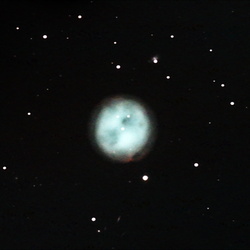
M97 (Owl Nebula)
M97 - Owl Nebula The Owl Nebula is a planetary nebula with two dark "eyes" that give it its owl-like appearance. It's one of the more complex planetary nebulae. Distance: 2,030 light-years Apparent Magnitude: 9.90 Apparent Size: 3.4' × 3.3' Constellation: Ursa Major Object Type: Planetary Nebula Key Features: - Two dark "eye" regions - Complex triple-shell structure - Central star magnitude 16 - 6,000 years old - Faint outer halo Best Imaging Season: January - May Optimal Integration: 8+ hours (OIII)
Barnard 39
Barnard 39
Barnard 39 - Dark Nebula Barnard 39 is a dark nebula in the Milky Way, a cloud of interstellar dust that blocks light from stars behind it. Distance: ~500 light-years Constellation: Scorpius Object Type: Dark Nebula Key Features: - Dense dust cloud - Blocks background starlight - Part of dark nebula catalog - Requires wide-field imaging - Best seen in rich Milky Way fields Best Imaging Season: May - July Optimal Integration: 6+ hours
Barnard 150
Barnard 150
Barnard 150 - Dark Nebula Barnard 150 is a dark nebula appearing as a dark elongated cloud against the rich starfields of Cygnus. Distance: ~600 light-years Constellation: Cygnus Object Type: Dark Nebula Key Features: - Elongated dark cloud - Part of Cygnus molecular clouds - Blocks background stars - Requires dark skies - Interesting contrast target Best Imaging Season: June - October Optimal Integration: 8+ hours
Barnard 312
Barnard 312 (!)
Barnard 312 (B312) is a large, prominent dark nebula in the constellation Scutum, located roughly 2,000 light-years away within the rich star fields of the Milky Way. Positioned near the Eagle Nebula (M16) and Omega Nebula (M17), it appears as a stark, mushroom shaped silhouette against a dense, bright backdrop of stars. Dark nebulae like B312 are dense clouds of interstellar dust and gas that block visible light from objects behind them, creating striking void like shapes against illuminated star fields. First catalogued by Edward Emerson Barnard in his 1919 photographic survey of dark nebulae, B312 is one of the most visually dramatic entries in the catalogue. Imaged with an Orion 8 inch Newtonian reflector and Canon T3i (full spectrum modified), 46x180s exposures captured in N.I.N.A 3.1 and stacked in Siril 1.4.0.