Backyardastronomy.net

Astrophotography Gallery

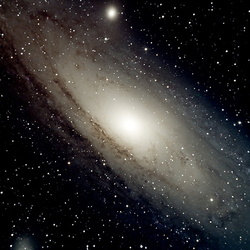
M31 (Andromeda Galaxy)
M31 - Andromeda Galaxy The Andromeda Galaxy is the nearest major galaxy to the Milky Way and the largest galaxy in the Local Group. At 2.5 million light-years away, it's the most distant object visible to the naked eye. Distance: 2.537 million light-years Apparent Magnitude: 3.44 Apparent Size: 190' × 60' (6x Moon diameter) Constellation: Andromeda Morphology: SA(s)b (barred spiral) Key Features: - Contains ~1 trillion stars (2.5x Milky Way) - 14 known dwarf satellite galaxies - M32 and M110 visible in wide-field images - Double nucleus discovered by Hubble - Approaching Milky Way at 110 km/s (collision in 4.5 billion years) Best Imaging Season: August - February Optimal Integration: 20+ hours for detail
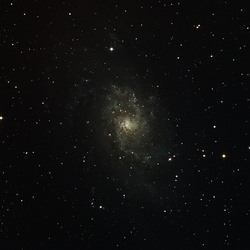
M33 (Triangulum Galaxy)
M33 - Triangulum Galaxy The Triangulum Galaxy is the third-largest member of the Local Group after Andromeda and the Milky Way. It's notable for its spectacular spiral arms and numerous HII regions. Distance: 2.73 million light-years Apparent Magnitude: 5.72 Apparent Size: 70' × 42' Constellation: Triangulum Morphology: SA(s)cd (spiral) Key Features: - Contains NGC 604 (one of largest HII regions known) - ~30 billion stars - Weak central bar structure - Excellent target for showing spiral structure - No prominent bulge, face-on orientation Best Imaging Season: September - February Optimal Integration: 15+ hours for HII regions
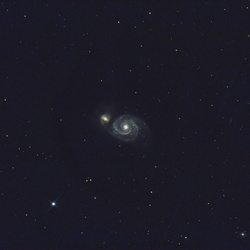
M51 (Whirlpool Galaxy)
M51 - Whirlpool Galaxy The Whirlpool Galaxy is a classic face-on spiral galaxy interacting with its smaller companion NGC 5195. This interaction has enhanced star formation and created the galaxy's spectacular spiral structure. Distance: 23 million light-years Apparent Magnitude: 8.36 Apparent Size: 11' × 7' Constellation: Canes Venatici Morphology: SA(s)bc pec (grand design spiral) Key Features: - Classic grand design spiral structure - Interacting with NGC 5195 (smaller companion) - Enhanced star formation from tidal interaction - Prominent dust lanes in spiral arms - First galaxy recognized to have spiral structure (Lord Rosse, 1845) Best Imaging Season: March - June Optimal Integration: 10+ hours for structure
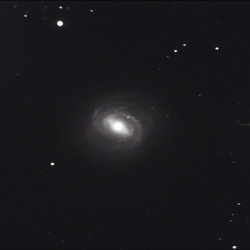
M58
M58
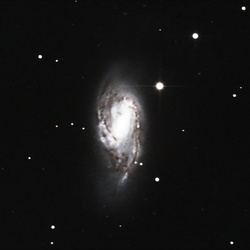
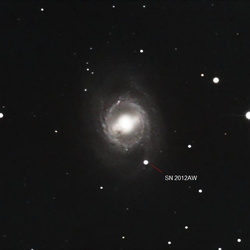
M58 - Barred Spiral Galaxy M58 is one of the brightest barred spiral galaxies in the Virgo Cluster. It has hosted two supernovae in recent decades (1988A and 1989M). Distance: 62 million light-years Apparent Magnitude: 9.66 Apparent Size: 6' × 4.5' Constellation: Virgo Morphology: SB(r)b (barred spiral) Key Features: - Member of Virgo Cluster - Strong central bar structure - Two supernovae observed (1988, 1989) - Compact, bright nucleus - Active star formation in spiral arms Best Imaging Season: March - July Optimal Integration: 8+ hours
M61
M61
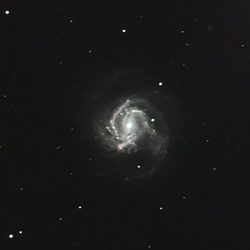
M61 - Barred Spiral Galaxy M61 is a face-on barred spiral galaxy in the Virgo Cluster, notable for its active galactic nucleus and prolific supernova production (7 observed since 1926). Distance: 52 million light-years Apparent Magnitude: 9.65 Apparent Size: 6' × 5.5' Constellation: Virgo Morphology: SAB(rs)bc (barred spiral) Key Features: - Active starburst galaxy - 7 supernovae recorded (most in Messier catalog) - Member of Virgo Cluster - Bright stellar nucleus - Extensive HII regions in spiral arms Best Imaging Season: March - July Optimal Integration: 10+ hours
M63 (Sunflower Galaxy)
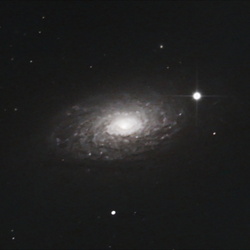
M63 (Sunflower Galaxy, NGC 5055) The Sunflower Galaxy is a spiral galaxy in the constellation Canes Venatici, located approximately 27 million light-years from Earth. M63 is a member of the M51 Group, a collection of galaxies that includes the famous Whirlpool Galaxy (M51). It earned its common name from the bright, patchy appearance of its spiral arms, which resemble the pattern of seeds on a sunflower head. Distance: 27 million light-years Apparent Magnitude: 9.3 Apparent Size: 12.6 x 7.2 arcminutes Constellation: Canes Venatici Object Type: Spiral Galaxy (SA(rs)bc) Discovery: June 14, 1779 by Pierre Mechain M63 contains roughly 400 billion stars and exhibits a faint tidal stellar stream, suggesting it gravitationally disrupted a smaller companion galaxy in the past. The galaxy was one of the first spiral nebulae in which spiral structure was recognized, observed by William Herschel in 1788. It is also classified as a flocculent spiral galaxy, meaning its spiral arms are patchy and discontinuous rather than well defined. Imaging Details: Telescope: Orion 8 inch 1000mm f4.9 Newtonian Reflector Mount: Orion Atlas EQ-G Camera: Canon T3i (Full Spectrum Modified) Guide Scope: Meade 800mm f10 reduced to f5 Guide Camera: Meade DSI Pro Monochrome Integration: 100 x 180sec (5 hours total) Capture Software: N.I.N.A 3.1 Stacking: Siril 1.4.0
M66
M66
M66 - Barred Spiral Galaxy M66 is the largest member of the Leo Triplet, a group of three interacting galaxies. Its asymmetric spiral arms show signs of tidal interaction with its neighbors. Distance: 31 million light-years Apparent Magnitude: 8.92 Apparent Size: 9' × 4' Constellation: Leo Morphology: SB(s)b (barred spiral) Key Features: - Member of Leo Triplet (with M65 and NGC 3628) - Asymmetric spiral arms from tidal interaction - Bright nucleus with prominent dust lanes - Recent supernova in 2009 - Active star formation regions Best Imaging Season: January - May Optimal Integration: 8+ hours
Leo Triplett (M66 Group)
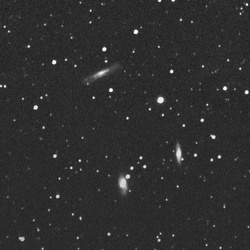
Leo Triplet (M66 Group) The Leo Triplet is a small group of three interacting spiral galaxies located about 35 million light-years away. The gravitational interaction between these galaxies has created spectacular tidal tails and distorted structures. Distance: 35 million light-years Members: M65, M66, NGC 3628 Constellation: Leo Group Members: - M65: SA(s)a spiral, slightly tilted - M66: SB(s)b barred spiral, largest member - NGC 3628: Edge-on spiral with prominent dust lane Key Features: - Gravitational interaction visible in deep images - NGC 3628 shows tidal tail extending 300,000 light-years - All three visible in single wide-field frame - Popular target for astrophotographers Best Imaging Season: January - May Optimal Integration: 15+ hours for tidal features
M73 (Sunflower Galaxy)
M63 - Sunflower Galaxy M63, also known as the Sunflower Galaxy, is a flocculent spiral galaxy with a bright central region and patchy, fragmentary spiral arms that resemble a sunflower. Distance: 27 million light-years Apparent Magnitude: 8.54 Apparent Size: 12' × 8' Constellation: Canes Venatici Morphology: SA(rs)cd (flocculent spiral) Key Features: - Flocculent (patchy) spiral structure - Bright central bulge - Multiple spiral arm fragments - Part of M51 group - Supernova observed in 1971 Best Imaging Season: March - June Optimal Integration: 10+ hours
M81
M81
M81 - Bode's Galaxy M81 is a grand design spiral galaxy and one of the brightest galaxies visible from Earth. Its near-perfect spiral structure makes it a classic example of its type. Distance: 11.8 million light-years Apparent Magnitude: 6.94 Apparent Size: 27' × 14' Constellation: Ursa Major Morphology: SA(s)ab (grand design spiral) Key Features: - Classic grand design spiral structure - Interacting with M82 (nearby) - Central supermassive black hole (70 million solar masses) - Active galactic nucleus - Bright stellar associations in spiral arms Best Imaging Season: January - May Optimal Integration: 12+ hours
M82
M82
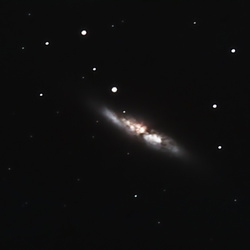
M82 - Cigar Galaxy M82 is a starburst galaxy experiencing intense star formation, likely triggered by interaction with M81. Its edge-on orientation reveals spectacular dust lanes and red hydrogen jets. Distance: 11.5 million light-years Apparent Magnitude: 8.41 Apparent Size: 11' × 4' Constellation: Ursa Major Morphology: I0 (starburst irregular) Key Features: - Intense starburst activity (10x Milky Way rate) - Red hydrogen jets perpendicular to disk - Edge-on orientation shows dust lanes - Interacting with M81 - 197 supernova remnants detected - Galactic wind from starburst activity Best Imaging Season: January - May Optimal Integration: 8+ hours for jets
M83 (Southern Pinwheel Galaxy)
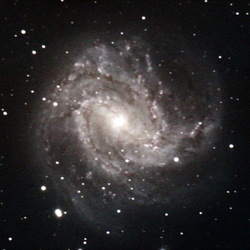
M83 - Southern Pinwheel Galaxy M83 is a face-on barred spiral galaxy often compared to M101 for its similar appearance. It holds the record for the most supernovae discovered in any Messier galaxy. Distance: 14.7 million light-years Apparent Magnitude: 7.54 Apparent Size: 15' × 13' Constellation: Hydra Morphology: SAB(s)c (barred spiral) Key Features: - Face-on grand design spiral - 6 supernovae recorded - Strong central bar - Active star formation in spiral arms - Resembles M101 (Northern Pinwheel) Best Imaging Season: March - July Optimal Integration: 12+ hours
M86
M86
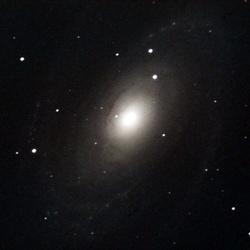
M86 - Lenticular Galaxy M86 is a lenticular galaxy in the Virgo Cluster, notable for its high blue shift (approaching us) and being one of the largest galaxies in the cluster. Distance: 52 million light-years Apparent Magnitude: 8.90 Apparent Size: 9' × 6' Constellation: Virgo Morphology: S0-1/E3 (lenticular/elliptical) Key Features: - Member of Virgo Cluster - Approaching us at 419 km/s (blue shift) - Large central bulge - Little ongoing star formation - Surrounded by intracluster gas Best Imaging Season: March - July Optimal Integration: 6+ hours
M87
M87
M87 - Virgo A M87 is a supergiant elliptical galaxy and one of the most massive galaxies in the observable universe. It's famous for its relativistic jet and the first black hole ever imaged (Event Horizon Telescope, 2019). Distance: 53.5 million light-years Apparent Magnitude: 8.63 Apparent Size: 8' × 7' Constellation: Virgo Morphology: E0-1pec (giant elliptical) Key Features: - First black hole ever directly imaged (6.5 billion solar masses) - Relativistic jet extending 5,000 light-years - ~15,000 globular clusters (Milky Way has ~150) - Central galaxy of Virgo Cluster - Active galactic nucleus (blazar) Best Imaging Season: March - July Optimal Integration: 10+ hours for jet